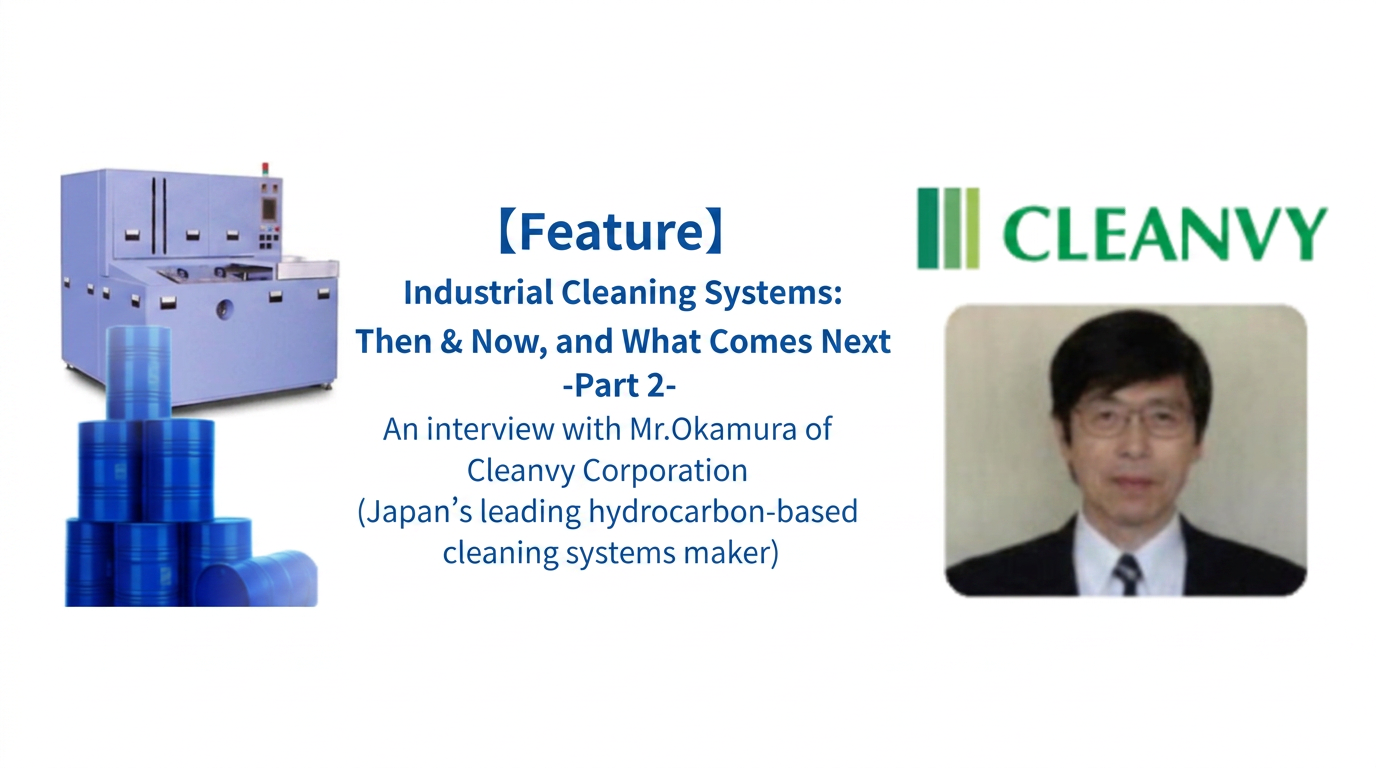
We interviewed Mr. Kazuhiko Okamura, President of Cleanvy Corporation, a cleaning equipment manufacturer specializing in industrial cleaning with deep knowledge in the field, who is the creator of hydrocarbon-based cleaning machines 'CLEANVY' and 'CLOVA', and next-generation fluorinated cleaning machines 'FISTA' and 'FLOVA', about industrial cleaning machines past and future.
In Part 2, we asked him to discuss the future of industrial cleaning machines, including the global situation. Please read this together with Part 1.
※This article is [Part 1] of two parts (Part 1 and Part 2).
■ Cleanvy's Journey Alongside the History of Phasing Out CFCs
―――When we think of "Cleanvy," you have such name recognition that there's probably no one in the domestic industrial cleaning field who doesn't know you. First, if you don't mind, could you tell us about "how Cleanvy came to be" and its history?
President Okamura: Cleanvy was established in 1995, which was also the year of complete CFC abolition. Therefore, it's no exaggeration to say we've walked alongside the flow of phasing out CFCs, but to talk about our establishment, we need to look back a bit at industrial cleaning, CFCs, and environmental issues. Let me go through these one by one.
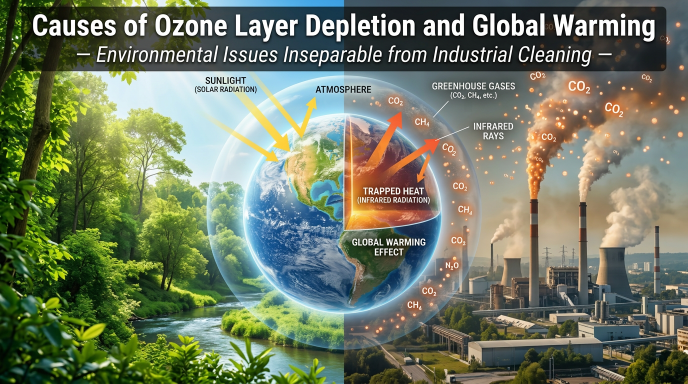
Before establishing Cleanvy, I worked as an engineer at Seiko Epson Corporation in the 1980s. The social background at that time was that ozone layer depletion was being viewed as a problem globally, and activities to prevent global warming were becoming active. Then in 1987, the Montreal Protocol was adopted, determining that specified CFCs used in industrial products such as refrigerants and cleaning solvents would be phased out gradually.
In the cleaning field, CFCs were mainstream due to their cleaning power, ease of handling, and harmlessness to humans. However, it was also decided that these CFCs would be completely abolished by 1995, and "So what are we going to use as cleaning agents instead of CFCs?" became one focal point.
―――It must be confusing when something you've been using suddenly becomes unusable.
President Okamura: Exactly right. Some people were saying "CFC manufacturers will quickly create the next CFC that clears environmental issues," while others were saying "New CFCs can't come out that quickly, what should we do..." - it was a troubling problem.
In reality, from 1987 to 1995 wasn't even 10 years. That's why there were many voices saying "We need to do something now!" Some companies temporarily switched to other cleaning agents like chlorinated ones as interim measures, while others decided to shift to aqueous systems as a permanent solution.
At that time, Seiko Epson not only proactively addressed environmental issues but declared "We will completely abolish CFCs at our company!" two years ahead of schedule, by 1993 instead of 1995. Then a "CFC Phase-Out Project" was launched within the company, and I was selected as one of its members.
■ The Arrival of the "Hydrocarbon Cleaning" Era Revealed Through Challenges
――So your experience at that time led directly to the current Cleanvy.
Yes, that's right. At the time, the main options for cleaning agents were primarily three: "waiting for new CFCs to be developed," "aqueous systems," and "hydrocarbon systems." And when I was at Seiko Epson, we focused on aqueous cleaning. This was as a result of considering safety.
For example, "hydrocarbon-based solvents" are also called "petroleum-based solvents" as they're made from petroleum as a raw material. One thing that's superior to aqueous systems is their high degreasing power. However, as a disadvantage, being oil-based, there's the risk of fire.
――While at Seiko Epson, you didn't pursue hydrocarbon-based cleaning due to safety concerns. So why was Cleanvy, which now has the top domestic market share in that field, born?
Perhaps it's because we focused on aqueous cleaning that we were also able to perceive the challenges of aqueous cleaning. One excellent aspect of aqueous cleaning is that there's little danger of fire. However, compared to hydrocarbon systems, the cleaning power is inferior, and there's also the disadvantage that large-scale facilities must be prepared for implementation.
If you're a large company that can adequately prepare wastewater treatment facilities, there may be no problem. However, in terms of cleaning machine demand in Japan, small and medium-sized enterprises account for the majority, and it's not easy for all small and medium enterprises to adequately install wastewater treatment facilities.
This means that as options small and medium enterprises could take in the flow of phasing out CFCs, it was either to wait for the development of new CFCs or to switch to hydrocarbon-based cleaning. Furthermore, since the development of new CFCs should take time, I came to think "the era of hydrocarbon-based cleaning is coming." This was the trigger for my independence and starting to move toward establishing Cleanvy.
■ Birth of the "Closed System" That Changed Conventional Concepts
―――So Cleanvy was born alongside the history of phasing out CFCs while meeting social needs. One thing I'm curious about is, you mentioned "hydrocarbon-based cleaning has fire hazards," but how did you overcome that point?
Regarding fire hazards, we achieved a solution by focusing on oxygen. When I was troubled about the challenges of hydrocarbon-based cleaning, the idea suddenly came to me. "If it's in a vacuum state, wouldn't the fire hazard be eliminated?" In fact, this idea led to the development of what we call the "closed system" hydrocarbon-based cleaning machines that currently form the backbone of Cleanvy.
In conventional hydrocarbon-based cleaning machines, cleaning was performed by going through multiple cleaning tanks. At that time, it was necessary to take products in and out during the cleaning process, and oxygen inevitably entered. However, with a closed system that completes everything in one cleaning tank, there's no need to take products in and out during the cleaning process, so oxygen doesn't enter, and fire hazards can be avoided. This allowed us to clear the safety issues in hydrocarbon-based cleaning.
▼Watch this article as a video▼
▼Related Articles